Saturday, 26 November 2011

Creating concepts


I found making silhouettes quite helpful in finalising the basic shape and look of my character, however I found it hard to think of 100 for a single character, so I split it up and did some designs for the Gods and creatures in my game as well. I found my main character went in a completely different direction once I started experimenting with different shapes and took me in a whole new direction with how I wanted my game to look. This is why I didn’t want to focus too much on the design in the first project.

I started looking more into nature as it is a big part of my game concept and took inspiration from things like Pan’s labyrinth and Folklore where a lot of the characters have some natural element like parts of plant or trees growing on them or as part of them.


His feet turn into tree trunks at the bottom and the skin gets a bark like. His hair is made of grasses and vines.

Once the final design was done I started looking for pictures of cave paintings, to get a feel for the art style I was going for. I had to make the character itself look like a painted figure, and also use stone texturing on the background. I used a watercolour brush in Photoshop so that it would have a somewhat grainy texture. I also used a stone texture brush to add shading.

When it came round to doing a character sheet I found that there wasn’t much I could do, as my character does not really have any facial expression. So I did a series of different poses and movements instead, as well as some designs for NPC characters and creatures. 

Light 11/11/11


Light

Without light there is no colour, no form and no distance there would be nothing to see.

Light works in three different ways: absorption, reflection and refraction, these are the ways which light interacts with everything around us.

Absorption is when light hits a surface and is absorbed by it; a good example of this would be a surface with the colour black. We see it as black because it absorbs all the colours of light while something red absorbs blue and green light and reflects the red, hence why we see it as red.

Reflection is when light bounces off of and object at the same angle it came in at. Depending on the colour light that is reflected depends on the colour we see.

Refraction is when the beam of light is bent of course into another direction.

Defused reflection is when light bounces of an uneven surface and is scattered in all directions.

Shadows are affected by the distance of the object from the light source, intensity of the light source.


Shadow of the Colossus is well known for its beautiful environments, I think this has a lot to do with the lighting in the game. This image is an in game render of a fight between Wander and a Colossus. The light source in this picture is the sun that is breaking through the clouds from behind the colossus; this makes the colossus cast a large looming shadow over Wander and his horse. This emphasizes the size of the colossus.


Another colossus picture, in this one the light source is directly above, or in the middle of the picture. It is meant to replicate when you look up at the sky with the sun in your eyes, that’s why the light is quite overwhelming. The flying colossus, again to signify its size, blocks out the sun so it is almost a silhouette.


This is an environment piece from shadow of the colossus, there is a very strong light source coming from the right hand side of the image, making harsh light to shadow contrasts. The places where the light hits the tree roots and plants are almost white while the shadows behind them are quite dark. 


Tuesday, 22 November 2011

Composition 21/11/11

Divine proportions

“The height of a well proportioned man is equal to his out-stretched arm.” Marcus Vitruvius Pollio.


Leonardo da Vinci's drawings of the human body emphasized its proportion. The ratio of the following distances is the Golden Ratio: foot to navel and navel to the head.
A survey was taken to determine what rectangle was the most aesthetically pleasing the results showed that the favored ratio was 5:8 this is known as the golden section.

Different types of compositions
Root 2 rectangle construction
 
Root 3 spiral construction


Rule of thirds


Divide the picture into a grid of nine, the corners of the middle square are the focal points. 

Nigel method

Devide the page down the middle, then again diagonally on both sides, then draw lines horrisontally down the middle of the separate halves. The red dots represent the golden section. 

The “L”


This method is like making a frame within a frame, so it is framing a section of the picture that is the focal point. 

The cross


The cross is all about opposition and contrast. The virticle line is the leading line, this is usually where the main focus of the picture goes. The horizontal line is the stopper, this could be where the contrast happens like changes in colour or shadow. 


Iconic


This technique is often used in comic books with the classic hero in the middle pose. 

Things to think about when compiling a picture.


·      Focal points- Make sure you decide where you want your focal points and stick with them.
·      Vary you values- Mix it up a bit. Try switching from light on dark and dark on light, or between hot colours and cold colours to help draw attention to certain parts of your picture.
·      Odd elements- having odd numbers of elements in your picture makes it more aesthetically pleasing and makes it easier to compile.
·      Spacing- Make sure to think about the spacing between the elements.
·      KISSING IS BAD!! -Try not to have to things touching each other when there is a lot of spare space, spread them out.
·      Domination is good!- use dominating colours but through in a few contrasting ones as well.
·      Avoid the obvious
·      The spice of life- Don’t just stick to one type of composition ix them up. 

E    Examples


      This picture is the box art for the latest Zelda game on Nintendo Wii. This is an example of the cross composition. Though I think I might have got the centre line a little off. There is a clear virtical line going down the centre of the picture, shown by the column of light following down to the bottom of the crest on the logo. The horizontal line goes across where the two figures in the background are. There shoulder line or bottom of their faces is where the line goes across. 


      This is a piece of concept art from a Japanese RPG The Last Story. This is an example of Iconic composition, the main focus is the character in the middle and when drawing the lines you can clearly see that the 2 elements in the piece, the monster and the character, are in the golden area. Also the background and the angle the character is standing reflects the diagonal lines. 


      This promotional poster for the new Elder scrolls game is a classic example of iconic composition, the classic hero pose. It fits perfectly into the golden area and is obviously where it wants you to focus.  


E

E
E


Wednesday, 16 November 2011

Developing my ideas further


After my pitch, having shared my ideas I began to rethink some things to improve them and refine them. I added a lot more depth to the narrative and explained a lot more of the back-story in my design document.

One of the main changes was the art style of the game, I had said to my self all along that what I had already come up with was not the final design and if I could work on it to make it a lot better I would, even if it meant that it changed completely. However the game itself would stay the same even if it looked completely different.

As part of the character learning about what had happened I was going to have the Gods you meat give the character a sort of vision and it would appear in a very cave painting or wall carving type style, almost like a story book. I will be keeping this, however an idea was put to me to have the whole game in that style as I could do a lot of interesting things with stone textures and stylised characters. Therefore I have begun to look into different cultures ways of telling stories on walls, some are very intricate while other are quite crude but still beautiful in their own ways.

I also have put a lot more thought into heath bars and how the game will play, as well as how the powers you acquire are used to help you progress. I have also added collectables to regain heath and magic or to permanently increase them.

All of this is described in a lot more detail in the game design document.

Ratings and target audience


Looked at two different types of rating systems, that are usually found on game cases.
PEGI and BBFC
I rated it a 7 because the game will include some difficult challenges to progress through the levels.
Also contains mild violence, the player themselves will not be able to attack but things will come after you and attack if they get the chance, that is why I gave the violence warning.
PG – dark atmosphere to the game, some of the creatures are quite brutal and sinister. 


Plot

Narrative in games is very important to me and I really enjoyed coming up with one for my game. these are a few bullet points just to sum up the basic plot of my game.
•Ancient and magical civilization. (Mayan and Indian influences.)
• You play as a boy who is the son of the goddess.  
•They put him to sleep and lock him away deep within their elaborate temples, To preserve him and keep him hoping to be granted with great power. By doing so they bring chaos onto there world and soon everything disappears. The goddess turns her back on the people.
•1000 years later the goddess’ child wakes up and has to find his way out of the temples to rejoin the other gods.  Re-awakening his powers along the way. Collect magical feathers for your headdress gives you new powers, other deities you meet on your journey give you them upon reaching their temple/ or end of the level. 


I have gone into a lot more detail in my design document about the plot and have covered all of the story including back story and important stuff about what happened after the boy had been put to sleep. 

Influence Map


I thought I would put together a mood board to show all the things that are inspiring my game idea. I searched around for pictures from games, TV shows and films to fuel this board. In this image you can find pictures from Limbo, Outland, Studio Ghibli’s Laputa, Disney’s Atlantis, Journey, Zelda twilight princess and a few other things. I mentioned some of these in my pitch presentation when talking about art style. 

Wednesday, 9 November 2011

Limbo


Developed by Playdead
Published by Microsoft game studios

Limbo is a puzzle 2D side scroller platform game released on the Xbox 360, Playstation 3, and Microsoft windows through Steam. You play as a boy trying to find his sister and you have to guide him through dangerous and hazardous environments it has standard 2D platform controls, run left or right, jump, climb up and down etc, you can also make the boy interact with the environment by pushing and pulling objects. The environment has many hazards such as bear traps and multiple spike traps; there are also monster that hide in the shadows waiting for you to come along.

The puzzles and traps were specifically made that the player was meant to die on their first attempt at it; the idea behind this was that the player would learn their mistake and find the solution to the puzzle. This was nicknamed the “trial and error” method. They used gruesome imagery for the boy’s deaths, this was meant to deter the player from making the same mistake again.


Monochromic colouring, lighting, film grain effects and minimal ambient sounds were used to create a classic horror. 

Working through ideas


After researching and playing some games that I thought would help me with my game idea, I decided I wanted to stick with the side scrolling and exploration aspect of the original FRED game. So I focussed my research on games that shared these traits and began thinking about how to incorporate them. I wanted to do a fantasy like setting with a dark undertone and highly stylised look to it. Similar to that of Outland that relying heavily on silhouettes and built up layers of background. I liked the ancient civilisation concept as well, this would also fit with the original FRED as you are trying to get out of an Egyptian tomb.

The games I played were all if not most for home consoles so I thought about doing something a bit different and doing a home consol type of game but making it for the iPad and make use of it’s touch screen functions. I made a mock up of a the game screen to work out how the controls would work, in the left bottom corner of the screen is a glowing circle this acts as an analogue stick and on the other side in the bottom right there is a smaller circle which is the jump button. The environment and some platforms can be moved and manipulated using the iPad’s touch screen functions. Doing this also allowed me to play around with the layout of the screen and the style I was aiming for, however at this point I was not fixed on an art style. I also did a first concept idea for the main character but like the environment I will be working on it further. At this point I was also thinking about plot and what would be the goal for the character to progress through the game. I wanted to add a lot more in the narrative aspect of the game, as FRED had little to no plot, and being a person who is very much interested in plot in games got bored quite quickly. Apart from getting out of the tomb there wasn’t really much else to the plot of FRED although in the remake of the game more plot was added.

Friday, 4 November 2011

Outland

Developed by Housemarque
Published by Ubisoft
2011

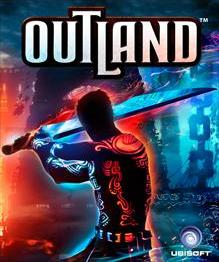
Outland cover.jpgOutland is a 2D platform game on the PlayStation Network. You play as a man who has recently been having visions and strange dreams seemingly of the past. He tries taking medicine to stop his visions but nothing happens. He then decides to seek a wise man or shaman who can help him with his problem. The shaman tells him what the dreams mean and how he can stop them. He tells the man that he is the reincarnation of the hero who stopped the two sister goddesses 30,000 years ago. The two sisters have escaped from their prison and now he must stop them. So he sets out on his journey to save the world.

You visit various temples along the way each time gaining some kind of new power, these usually signify the end of a level and some are guarded by boss fights. There are also different creatures along the way that you must face.

The unique feature of this game is the light and dark aspects to the game play, as the hero you can channel light and dark energy that you can switch between at any time. The two different energies are represented with different colours, light being blue and dark being red. In the game there are enemies of a certain colour that you can only encounter and defeat when you are switched to the opposite colour. The same applies to different colours of energy that may be being fired about the levels; to pass safely through them you need to be the same colour as the energy. The game is all about timing and fast thinking is needed making this game very challenging at times.

One of the main aspects of the game that I focussed on was the art style and how atmospheric it is. Everything in the foreground is a silhouette then the background is layered up behind it. The background themselves are beautiful to look at and it gives the game an overall dramatic feel to it.